

The report tracks over 7,000 tokenized physical assets across 12 asset classes, with a total value of US$60 billion.

In recent years, the tokenization of RWA (Real-World Assets) has continued to attract significant market attention; traditional assets such as government bonds, funds, and gold are progressively exploring new circulation models through on-chain technologies, while the scale, asset types, and application scenarios for RWA tokenization continue to expand.
BeInCrypto's latest report, "The Real State of DeFi in 2026," reveals that the RWA market is entering an accelerated growth phase.
This report tracks over 7,000 tokenized products, 12 asset categories, and approximately $60 billion in on-chain assets, providing a systematic overview of the current state and market landscape of real asset tokenization for 2026 (the data in this report are based on statistics as of May 31,2026).
This article will analyze the development of RWA tokenization in 2026 by integrating key report data and content.
I.The RWA market size has surpassed $60 billion, yet its value remains highly concentrated in a small number of assets
"The Real State of DeFi in 2026" reveals that RWAs are gradually transitioning from the proof-of-concept stage toward large-scale adoption.
The report provides statistical analysis of the tokenization market across three dimensions:
1⃣ The first layer consists of the core RWA tokenization market, where approximately $60 billion in real-world assets have been tokenized, covering categories such as U.S. Treasury bonds, asset-backed credit, commodities, equities, and real estate;
2⃣ The second layer represents a broader tokenized value layer; after the inclusion of stablecoins, the relevant scale expanded to approximately $360 billion;
3⃣ The third layer further incorporates institutional repurchase settlement activities into the statistics, with the corresponding settlement volume exceeding $695 billion.
These three figures provide insights into the development of tokenization from three distinct dimensions: assets, value circulation, and financial settlement; specifically, $60 billion reflects the current scale of core RWA assets, $360 billion represents the total value of on-chain tokenized assets, and $695 billion indicates that blockchain technology has already begun to enter institutional financial settlement scenarios.
However, from the perspective of asset distribution, the RWA market still exhibits a pronounced concentration pattern:
👉62 assets account for 88% of the total asset value: among these, five products—Figure HELOC, Circle USYC, Tether Gold, BlackRock BUIDL, and Justoken JMWH—collectively hold approximately half of the market share.
👇The detailed distribution of asset types is as follows👇

*Screenshot sourced from BeInCrypto
👉 U.S. Treasury bonds are currently the only asset class to have reached "investment-grade maturity": owing to their high liquidity, they significantly outperform other assets in terms of market acceptance; their total size is approximately $15 billion, encompassing more than 100 different products.

*Screenshot sourced from BeInCrypto
In contrast, assets such as commodities and real estate have already achieved monetaryization, but they remain in an exploratory phase due to challenges such as regulatory risks.
II.Asset on-chainization = asset circulation; insufficient market liquidity
Although a large number of assets have been successfully migrated to the blockchain, no sustained and active trading market has yet emerged. Many products resemble on-chain digital certificates—used to record and map off-chain assets—rather than serving as financial instruments that can be widely traded or utilized.
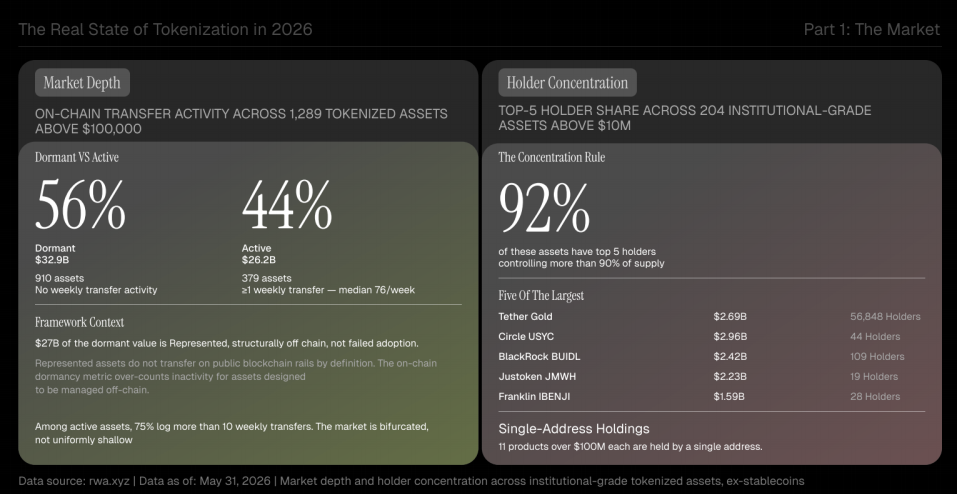
(1) Of the $60 billion, approximately $32 billion comprises "distributed assets"; the remaining approximately $27 billion comprises "representative assets".
🔶 Distributed Assets: Can be freely transferred on public blockchains and support integration and operations via wallets, CEX/DEX platforms, and DeFi protocols.
🔶 Representative Assets: A blockchain-based accounting or registration mechanism that records off-chain asset rights on the blockchain essentially merely documents the ownership status of off-chain assets, rather than representing tradable on-chain products.
The differences between these two asset types reflect the structural characteristics of the current RWA market: while the scale of tokenization is expanding rapidly, the actual on-chain adoption remains limited.
(2)Among the $60 billion, approximately half of the transactions did not involve weekly fund transfers.
The report data shows that among 1,289 tokenized assets valued at over $100,000, approximately 910 assets—totaling $32.9 billion in value—did not exhibit any weekly on-chain transfer records during the statistical period; a large number of products have lacked active trading for extended periods, with market liquidity remaining concentrated in a small number of leading assets.
*Screenshot sourced from BeInCrypto
At the same time, market participants remain relatively concentrated. Taking the United States as an example, 97% of bond-based tokenized products have not yet opened access to general retail investors, with only products totaling approximately $1.7 billion meeting the eligibility criteria for general retail participation.
From the current stage of development, RWA demonstrates that "assets can be tokenized on the blockchain," but has not yet proven that "assets can give rise to a broad and sustainably active market."
The causes of this phenomenon primarily lie in two aspects:
First, the regulatory framework has not yet fully adapted to cross-border tokenized assets: asset issuance, the jurisdictions of the participating parties, and the regulatory authorities involved often fall under different legal jurisdictions, and the alignment of disparate regulatory rules remains a major obstacle to market expansion.
The second issue is that market access restrictions affect asset liquidity efficiency: since the market primarily targets institutional investors, ordinary investors still have limited access to and opportunities to participate in the market, which to some extent constrains the liquidity effect of assets.
III.The next phase of RWA competition: evolving from "asset on-chain" to "asset availability"
The report argues that the core competitive focus for RWA in the next phase lies not in issuing more assets, but in refining the infrastructure that underpins tokenized operations.
The key to shaping the future market landscape lies not only in whether assets can be deployed on blockchains, but more importantly in whether they can cross-network transfer, comply with regulatory requirements, reach a broader user base, and truly integrate into the real financial system.
To transition from the current $60 billion scale to future markets of even greater size, at least three key infrastructure gaps still remain.
✫Lack of compliance mechanisms that bridge different regulatory frameworks; ✫Lack of distribution channels covering a broader range of users; ✫Lack of infrastructure that connects on-chain assets with institutional settlement networks.
At its core, the challenges facing the current RWA tokenization market are not "lack of assets," but rather that "the assets have not yet established a complete circulation system."
62 assets account for 88% of the market value, reflecting inadequate distribution capabilities; 97% of products cannot reach retail consumers, indicating that regulatory and entry mechanisms are not yet fully established; and a large number of assets remain underutilized over extended periods, suggesting that on-chain settlement and liquidity networks still require further development.
Globally, various regions are also strategically positioning themselves around this direction. In recent years, regulatory frameworks in areas such as stablecoins and RWA have been continuously refined, and the development of relevant infrastructure is gradually emerging as a new focal point of competition.
As an international financial center, Hong Kong is actively promoting the compliant development of RWA through measures such as introducing regulatory policies and launching pilot projects.
According to public reports, Hong Kong's first batch of compliant HKD-pegged stablecoins issued by the Hong Kong Monetary Authority (HKMA), named HKDAP, will be officially launched and issued no later than July 31,2026.
As a vital infrastructure component of the digital asset ecosystem, the introduction of Hong Kong dollar stablecoins will provide compliant value transfer channels for Hong Kong's RWA initiatives and facilitate the implementation of more practical application scenarios.
Note: Some of the content in this article is sourced from BeInCrypto's report titled "The Real State of Cryptocurrency in 2026"; no express or implied warranty is provided regarding the accuracy, completeness, or reliability of the information contained therein.
This article is intended solely for industry analysis and general informational purposes and does not constitute any investment advice; all copyright and final interpretation rights belong to ChainSee WEB3. Readers are advised to view this content rationally: the cryptocurrency market carries significant risks, and investors should exercise caution when investing.