

Stablecoins enter a new phase: for the first time, their commercial logic and regulatory compliance are deeply intertwined.

Recently, OSL Group, a global stablecoin payment and trading platform, jointly released a white paper with the Digital Assets and Innovation Centre of the School of Business at The Hong Kong Polytechnic University:《The Liquidity Hub of the Digital Economy: The Application, Value, and Opportunities for Hong Kong in the Use of Compliant Stablecoins within Modern Commerce》
The report points out that stablecoins are gradually being integrated into global cross-border trade and payment systems, becoming a crucial component of compliant digital payment infrastructure; specifically, the adoption of institutional-grade enterprise stablecoins is accelerating, serving as a significant supplement to the existing global stablecoin market.
As application scenarios continue to expand, the functional boundaries of institutional stablecoins are steadily broadening; leveraging advantages such as their programmability and global liquidity efficiency, stablecoins are gradually evolving from crypto asset tools into foundational components that connect enterprise payment and settlement systems.
I.Stablecoin Market Landscape: USDT and USDC Dominate; Institutional-Backed Enterprise Stablecoins Are Emerging
Currently, the global stablecoin market exhibits a pronounced concentration pattern, dominated by USDT and USDC; according to BitRue Research (May 2026), these two coins collectively control over 83% of the market share, while the remaining approximately 7% is held by other stablecoins such as FDUSD, DAI/USDS, and PYUSD.
USDT emphasizes stability and liquidity, while USDC prioritizes compliance and transparency; a comparison between the two is as follows:

*Screenshot sourced from SimianX
Beyond the "duopoly" landscape formed by USDT and USDC, the stablecoin market is witnessing new divergent trends: institutional-grade stablecoins represented by USDGO are beginning to emerge.
Note: USDGO is issued by Anchorage Digital Bank—regulated by the Office of the Comptroller of the Currency (OCC) and holding a federal banking license—and is subject to compliance management under the U.S. GENIUS Act, providing compliance endorsement services.
According to EY-Parthenon's 2025 survey of financial institutions and enterprises, approximately 13% of global financial institutions and enterprises are already using stablecoins in their daily operations—with a usage rate of 23% among financial institutions and 8% among enterprises; meanwhile, about 54% of organizations that have not yet adopted stablecoins expect to begin doing so within the next 6–12 months.
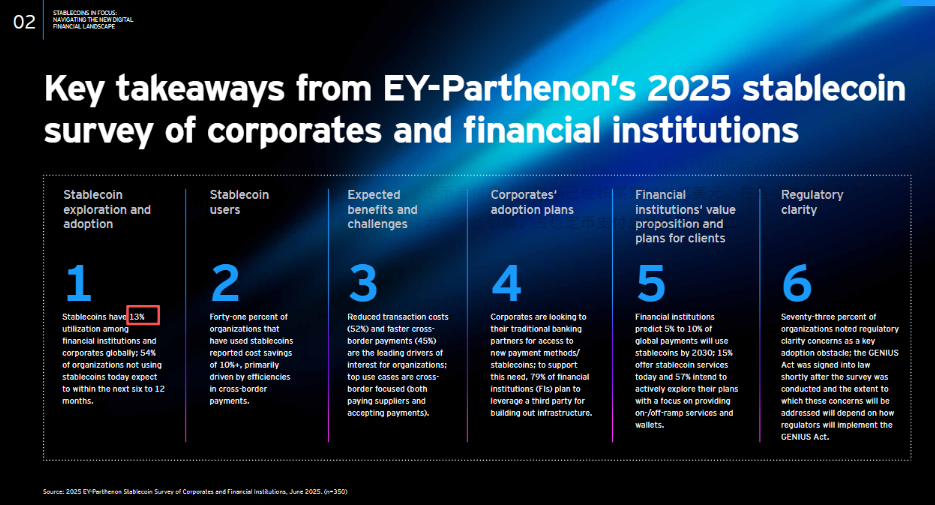

*Image sourced from EY-Parthenon
Unlike mainstream stablecoins designed for transactional and liquidity purposes, these institutional-grade stablecoins place greater emphasis on their compatibility with corporate financial systems; their underlying issuance and operational frameworks typically rely on financial institutions that hold regulatory qualifications.
As global enterprises' demand for cross-border operations and worldwide asset allocation continues to grow, the role of stablecoins is also evolving, with this transformation primarily manifesting in several key scenarios: cross-border payments between enterprises, supply chain fund settlement, optimization of treasury management, as well as fund flow and settlement requirements related to Real World Assets (RWA).
During this process, enterprises' demand for auditable, integrable digital USD tools with cross-border liquidity capabilities has continued to rise, driving stablecoins to gradually transition from being merely tools within the crypto market to becoming infrastructure components for corporate financial systems.
II.B2B Payments: The Most Critical Value Expansion Scenario Today
The application scope of stablecoins continues to expand—from their initial role as liquidity tools in the cryptocurrency market to gradually extending into corporate payments and financial infrastructure sectors, and further into a growing number of real-world business scenarios.
According to research by EY-Parthenon, cross-border payments represent the primary use case for enterprises employing stablecoins: 62% of such uses occur during cross-border supplier payments, while 53% are used for receiving cross-border commercial payments.
👉In terms of efficiency and cost performance, overall transaction costs were reduced by an average of 52%, while payment processing speeds increased by approximately 45%. Overall, across B2B cross-border payment scenarios, stablecoins demonstrate more pronounced advantages over the traditional SWIFT system in both cost and efficiency.


*Image sourced from EY-Parthenon
In practical scenarios, establishing cross-border payment pathways that connect mature financial markets such as Hong Kong with emerging markets has become one of the most representative implementation approaches for stablecoins, while also better demonstrating the adaptability of compliant stablecoins within real-world business operations.
As stablecoins gradually integrate into enterprise-level payment processes, their role becomes more intuitively evident in actual fund flows:
Funds flows are more verifiable:
on-chain transactions inherently preserve records; every payment is accompanied by a corresponding on-chain voucher, enabling the continuous tracking and verification of fund flow paths.
The cost expectations for the payment process are clearer
compared with traditional cross-border payments, which rely on multiple intermediaries and entail compounded fees and uncertainties regarding timing, the stablecoin approach is more direct, enabling enterprises to evaluate their cost structure and fund arrival timelines more clearly.
Cross-border settlement efficiency has been significantly enhanced
through the blockchain peer-to-peer transmission mechanism, fund transfers between different regions eliminate intermediate intermediaries, enabling near-instant settlement outcomes in certain scenarios.
III.The practical challenges facing institutions in accelerating their adoption of stablecoins
As stablecoin regulatory frameworks across various regions are gradually implemented, compliance pathways have become increasingly clear, the entry barriers for institutions have decreased, financial institutions and enterprises are accelerating their entry into relevant application scenarios, and the on-chain settlement volume has reached levels comparable to those of traditional mainstream payment networks.
The figure below presents the white paper's trend analysis regarding the future development of stablecoins.

*Screenshot sourced from the white paper*
The white paper points out that stablecoins are currently undergoing a critical turning point: for the first time, their commercial operational logic has been deeply integrated with regulatory compliance, enabling them to serve as a foundation for facilitating global B2B cross-border trade flows, while evolving from mere trading instruments into enterprise-level payment and settlement infrastructure.
However, in the actual implementation process, institutional advancement still faces multiple constraints and is influenced by various factors, which are primarily manifested in two aspects:
🔸First is the practical constraint at the compliance level. Cross-border payments involve regulatory requirements across multiple jurisdictions, and AML/CFT standards are not uniform; therefore, enterprises often need to comply with multiple regulatory frameworks simultaneously. Compliance issues have shifted from merely "whether the rules are clear" to a more complex question of "how to implement these rules in sync across multiple frameworks."
🔸The second aspect is the expansion of the competitive dimension. When stablecoins enter the enterprise-level payment sector, their competitors are no longer limited to similar products; instead, they enter the same competitive arena as the SWIFT system, interbank clearing networks, and traditional cross-border payment systems. While these systems operate at a slower pace and possess more complex structures, they also offer greater potential for long-term and deeper market reshaping.
Currently, the integration of encrypted payments with the traditional financial system is accelerating, and the demand for interconnection between different payment networks has risen significantly.
In practical implementation, this integration is primarily manifested at three levels: the fund transfers between on-chain systems and the banking system; the exchange and circulation arrangements among different fiat currencies; and the integration mechanism between digital wallets and offline payment networks.
As these components are progressively integrated, the focus of industry competition is also shifting—from a previous emphasis on individual product functionality to a broader competition centered on the overall efficiency and stability of cross-system fund flows.
The decisive factor in distinguishing outcomes is no longer individual capabilities, but rather the ability to establish high-efficiency, low-friction, compliant, and stable connectivity across different financial systems.
Note: Some of the content in this article is sourced from the document "The Liquidity Hub of the Digital Economy: The Application, Value, and Opportunities for Hong Kong in the Use of Compliant Stablecoins within Modern Commerce," jointly published by OSL and The Hong Kong Polytechnic University, as well as publicly available online materials. This article makes no explicit or implied warranty regarding the accuracy, completeness, or reliability of the information provided; should any copyright infringement occur, please contact us for modification or removal. This article is intended solely for industry analysis and general educational purposes and does not constitute any investment advice. The copyright and final right of interpretation of this article belong to ChainJian WEB3. Readers are advised to view this content rationally, as the cryptocurrency market carries significant risks, and investors should exercise caution when investing.